

The Cognitive Outsourcing Problem
Why the boardroom may be the next place where human judgement quietly atrophies

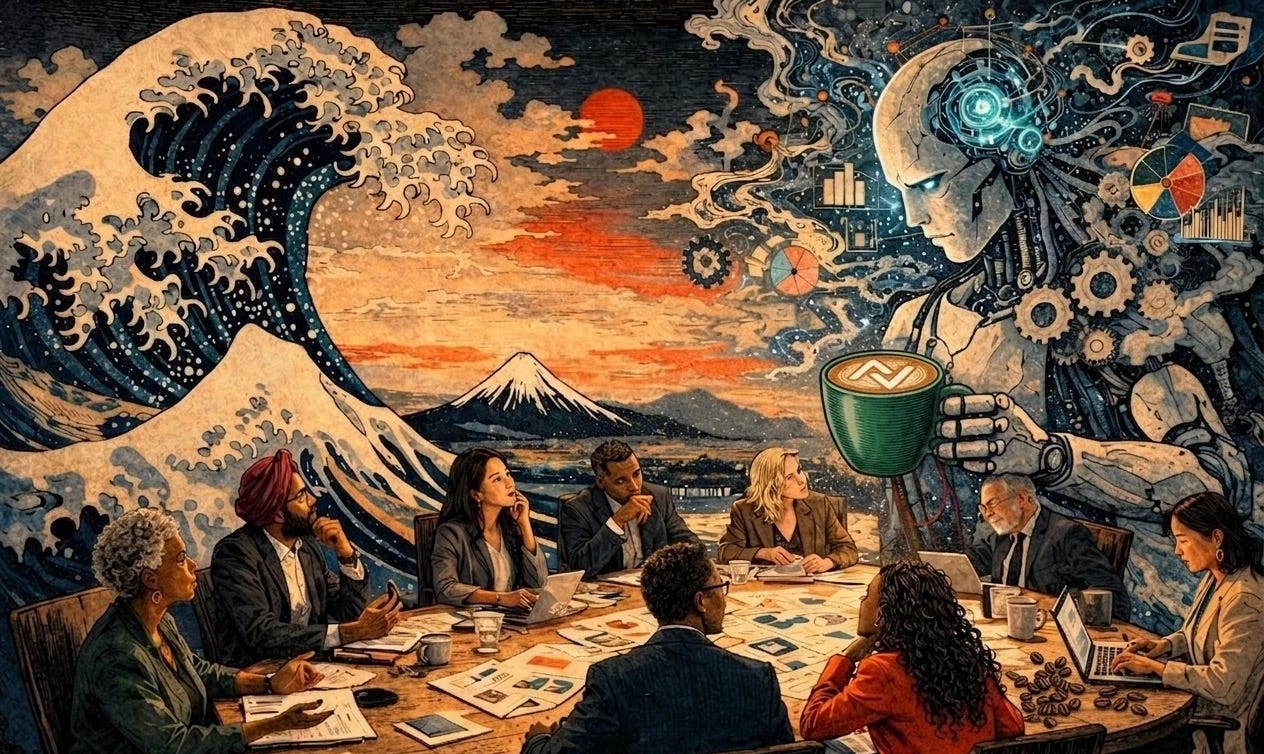
Over the past two years, artificial intelligence has entered the executive suite with remarkable speed.
The technology was initially marketed as an efficiency tool.
A faster way to summarise information, analyse data, or draft documents.
But something more consequential appears to be happening.
Increasingly, executives are not simply using AI.
They are deferring to it.
Recent research commissioned by Confluent and conducted by the market research firm 3Gem surveyed 200 UK business leaders: owners, founders, CEOs and other C-suite executives.
The findings are striking.
62% report using AI to make the majority of their decisions.
70% say they second-guess their own judgement when it conflicts with AI recommendations.
46% now rely more on AI than on the advice of colleagues.
Decision-making, according to 65% of those surveyed, has become less collaborative since AI entered the boardroom.
The technology has quietly acquired a seat at the table.
And increasingly, it is speaking last.
The Automation Paradox

This development fits into a well-known pattern in the history of automation.
When machines take over routine tasks, human capability can erode.
The phenomenon has been documented repeatedly:
• airline pilots losing manual flying skills due to autopilot reliance;
• drivers becoming inattentive when using advanced driver-assistance systems;
• GPS reducing human navigation abilities;
• calculators weakening mental arithmetic.
The paradox is simple.
Automation improves efficiency.
But by removing routine practice, it also erodes the very skills humans need when systems fail.
The same dynamic now appears to be emerging in cognitive work.
A recent study by Carnegie Mellon University and Microsoft surveyed more than 300 knowledge workers and analysed over 900 examples of AI use in professional tasks.
The conclusion was uncomfortable.
Workers who trusted AI more engaged in significantly less critical thinking.
Their role shifted from solving problems to passively supervising machine output.
In routine tasks especially, users often stopped interrogating the system’s answers altogether.
Over time, this produces what some researchers call cognitive offloading.
The machine thinks.
The human oversees.
Until eventually the human stops thinking very much at all.
The Rise of Cognitive Debt

Danish psychiatrist Søren Dinesen Østergaard has given this phenomenon a name:
cognitive debt.
Just as financial debt accumulates when spending exceeds income, cognitive debt accumulates when intellectual effort is persistently outsourced to machines.
Reasoning ability is not innate.
It is a trained capability.
It develops through repetition, argument, analysis, writing, and problem solving.
If those activities disappear, the underlying capability weakens.
Østergaard worries that the long-term consequence may be generational.
Future scientists, engineers, and executives may simply have fewer opportunities to develop the intellectual discipline required for breakthrough thinking.
A troubling possibility.
The next Demis Hassabis or John Jumper, whose AI system AlphaFold revolutionised protein folding, may not emerge in an environment where the intellectual work that trains such minds has already been automated.
The Boardroom Version

The corporate implications are already visible.
Executives are under intense pressure to make decisions faster than ever.
According to the Confluent research:
92% of leaders say decision speed has increased significantly in the past three years.
In that environment, AI appears attractive.
It provides quick answers.
It offers the appearance of neutrality.
It reduces stress.
But something subtle is changing in the psychology of leadership.
When 70% of executives report second-guessing themselves if their judgement conflicts with AI, authority has quietly shifted.
The executive is no longer the decision-maker.
They are increasingly the approver of machine recommendations.
This may feel efficient.
But it raises an important question.
If the machine’s recommendation becomes the default, what exactly is the human contribution?
The Tesla Lesson

The risks of automation complacency are already visible in other domains.
Consider the growing number of incidents involving Tesla’s “Full Self-Driving” system.
Drivers are told that the system requires constant supervision.
Yet time and again the same pattern appears.
The automation performs well enough most of the time that drivers become complacent.
Attention drifts.
When the system fails, the human is too disengaged to intervene.
The automation paradox strikes again.
The same psychological mechanism may be emerging in the boardroom.
If executives increasingly defer to AI recommendations, they may gradually lose the habit of independent judgement.
And when the system makes a mistake, as all systems inevitably do, the organisation may discover that the human oversight layer has quietly atrophied.
Human-in-the-Loop Is Not Enough

The current policy answer to this problem is often framed as Human-in-the-Loop (HITL).
In theory, this means AI systems provide recommendations but humans retain ultimate decision authority.
In practice, however, the research suggests something more complex is happening.
Humans may remain formally in the loop.
But psychologically they drift out of the loop.
When a system consistently provides confident recommendations, people tend to defer to it.
Especially under time pressure.
Human-in-the-loop can therefore degrade into something closer to Human-on-the-Loop.
And eventually into Human-after-the-fact.
The Infrastructure Argument

Interestingly, the Confluent study itself reaches a different conclusion.
The authors argue that the real problem is not AI reliance.
It is poor data infrastructure.
Executives often rely on instinct or AI because they lack timely, reliable information.
The proposed solution is real-time data streaming systems capable of feeding both humans and machines with continuously updated information.
There is merit in that argument.
Better data almost always improves decision-making.
But it does not eliminate the deeper issue.
Even with perfect data, judgement still matters.
And judgement is a capability that deteriorates without use.
The Strategic Question

The deeper question for companies is therefore not technological.
It is institutional.
How do organisations adopt AI without slowly eroding the decision capabilities of the people running them?
Some industries have confronted similar problems before.
Aviation, for example, now requires pilots to regularly fly aircraft manually to maintain skill levels.
Military command structures deliberately rotate officers through operational roles to prevent strategic detachment.
The lesson is simple.
Capabilities that are not exercised do not remain intact.
What Boards Should Be Asking

As AI becomes embedded in executive workflows, boards should begin asking a new set of questions.
Not about technology.
But about judgement.
For example:
Where are AI recommendations currently influencing major decisions?
Which decisions must always involve independent human reasoning before AI input is considered?
How often do senior executives make decisions without algorithmic assistance?
What processes ensure that AI outputs are actively challenged rather than passively accepted?
And perhaps most importantly:
Are we building organisations that think faster,… or organisations that think less?
The Weekend Takeaway

Artificial intelligence is an extraordinary tool.
Used well, it will make organisations more capable, not less.
But every powerful technology carries unintended consequences.
The emerging evidence suggests one of those consequences may be cognitive outsourcing.
The risk is not that AI replaces executives.
The risk is that executives gradually stop exercising the very capabilities that made them valuable in the first place.
Machines are improving at pattern recognition.
But strategy, judgement, and responsibility remain human functions.
For now.
The companies that thrive in the age of AI may therefore not be the ones that automate the most thinking.
They will be the ones that remember which thinking must never be automated.
🧠 Techie Corner for the Non-Techies

To understand what is happening in the boardroom right now, it helps to understand a few technical ideas that sit behind modern AI systems.
None of them are complicated.
But together they explain why executives are increasingly tempted to let machines “think” for them.
1. Large Language Models are Pattern Engines, Not Reasoning Engines
Most AI tools used in business today (e.g. ChatGPT, Claude, Gemini, Copilot, Mistral), are built on what are called Large Language Models (LLMs).
They work by analysing vast amounts of text and learning statistical patterns in language.
When you ask them a question, they do not actually “think”.
Instead they generate the most statistically probable sequence of words given the prompt and the training data.
This is extremely powerful for tasks like:
• summarising documents
• drafting reports
• generating code
• analysing structured information
But it also explains two important limitations.
First, LLMs do not truly understand the world.
Second, they are capable of producing answers that sound extremely confident even when they are wrong.
This is why researchers refer to AI errors as hallucinations.
The system is not lying.
It is simply generating plausible language.
2. AI Confidence is Psychological, Not Mathematical
Humans are extremely sensitive to confidence signals.
When a colleague expresses an opinion forcefully, we tend to assume they know what they are talking about.
AI systems produce answers in exactly this style.
Clear.
Structured.
Authoritative.
But the system is not expressing confidence in a statistical sense.
It is merely producing language that sounds confident.
That makes AI unusually persuasive.
In experiments, people often defer to AI recommendations even when they are wrong.
This phenomenon is called automation bias.
3. Automation Bias Is Why Humans Stop Challenging Machines
Automation bias occurs when humans trust an automated system more than their own judgement.
It has already been documented in many fields:
• aviation autopilot systems
• medical decision-support tools
• autonomous driving
• military command systems
Once a system performs well most of the time, people gradually stop questioning it.
Attention drops.
Humans begin to act as passive supervisors rather than active decision-makers.
When the system fails, the human oversight layer is often too disengaged to intervene.
4. Cognitive Offloading: Letting the Machine Do the Thinking
Another concept researchers are studying is cognitive offloading.
This simply means moving mental tasks from the human brain to an external tool.
We already do this constantly:
• calculators for arithmetic
• GPS for navigation
• search engines for memory
AI expands this idea into higher-level cognitive tasks.
Instead of outsourcing calculation or navigation, people are now outsourcing:
• analysis
• writing
• strategic thinking
• problem solving
That is a much bigger shift.
Because those activities are how humans maintain and strengthen reasoning ability.
5. Why This Creates “Cognitive Debt”
If you stop exercising a muscle, it weakens.
The same principle applies to intellectual skills.
Researchers have begun describing the result as cognitive debt.
Each time a person lets the machine do the thinking, they save effort in the short term.
But over time they may lose the mental capability required to solve problems independently.
It is similar to what happened in aviation.
When aircraft became heavily automated, pilots lost some manual flying skills.
Airlines now require pilots to regularly fly aircraft manually to maintain competence.
The same lesson may soon apply to knowledge work.
6. Human-in-the-Loop Only Works If the Human Is Actually Thinking
Many AI systems are designed with what engineers call Human-in-the-Loop oversight.
The idea is simple:
The machine makes a recommendation.
The human makes the final decision.
But this safeguard only works if the human actively evaluates the output.
If the human simply approves the recommendation without thinking, the safeguard disappears.
And the system effectively becomes machine decision-making with human rubber-stamping.
The Bottom Line
AI is becoming extraordinarily capable.
But its greatest risk may not be technological.
It may be psychological.
Machines are not replacing human judgement.
They are quietly tempting humans to stop exercising it.
📚 Further reading
Microsoft Research & Carnegie Mellon University: The Impact of Generative AI on Critical Thinking: Self-Reported Reductions in Cognitive Effort and Confidence Effects From a Survey of Knowledge Workers (2025)
Survey of 319 knowledge workers showing that higher trust in generative AI is associated with reduced critical thinking effort and increased cognitive offloading.Confluent & 3Gem Research: Quick Thinking - Striking the Balance Between Instinct and Insight (2024)
Research based on surveys of UK CEOs and C-suite executives analysing how time pressure, data availability and intuition shape executive decision-making.Confluent & 3Gem Research: Quick Thinking 2.0 - Balancing AI, Instinct and Insight (2026)
Updated survey of 200 UK business leaders showing rising reliance on AI for executive decision-making and highlighting the growing role of real-time data infrastructure in boardroom decisions.SAE International: Taxonomy and Definitions for Terms Related to Driving Automation Systems for On-Road Motor Vehicles (SAE J3016) (2021)
Industry standard defining levels of driving automation and clarifying that systems such as Tesla’s “Full Self-Driving” remain driver-supervised technologies requiring continuous human oversight.The Register: Supposedly Big-Brained Execs Are Outsourcing Decisionmaking to AI (2026)
Technology news coverage summarising the Confluent/3Gem survey results and discussing the implications of growing AI reliance in executive decision processes.ACM CHI Conference on Human Factors in Computing Systems: The Impact of Generative AI on Critical Thinking(2025)
Empirical study demonstrating that routine use of generative AI correlates with lower cognitive engagement and reduced analytical effort among users.arXiv: System 0: Transforming Artificial Intelligence into a Cognitive Extension (2025)
Proposes a framework in which AI functions as an external cognitive layer that reshapes human reasoning and decision processes.arXiv: Understanding Critical Thinking in Generative Artificial Intelligence Use: Development and Validation of the Critical Thinking in AI Use Scale (2025)
Introduces a validated measurement scale for assessing how users verify and critically evaluate AI-generated outputs.arXiv: “It Makes You Think”: Provocations Help Restore Critical Thinking to AI-Assisted Knowledge Work (2025)
Experimental research showing that introducing “provocations” or challenges to AI output can restore critical reasoning in AI-assisted tasks.arXiv: AI, Metacognition, and the Verification Bottleneck: A Longitudinal Study of Human Problem-Solving (2026)
Longitudinal research indicating that as AI becomes integrated into workflows, verification of AI outputs becomes the central bottleneck in human-AI decision systems.
Last Week on Something for the Weekend
Last week’s article examined a structural reality in the AI safety debate.
Many early frameworks assumed that developers would voluntarily slow progress if model capabilities outpaced available safeguards.
But in competitive technology races, incentives rarely remain aligned.
Once one actor accelerates, restraint becomes a disadvantage.
The result is a familiar dynamic seen in cyber risk, financial markets, and industrial competition: systems optimise around incentives, not intentions.
The takeaway was simple.
In high-speed technology races, voluntary safety rarely survives competitive pressure.
Read here: 👇
The (Technology ...and AI) Competitive Trap

Over the past few years, the conversation around artificial intelligence has often centred on safety: